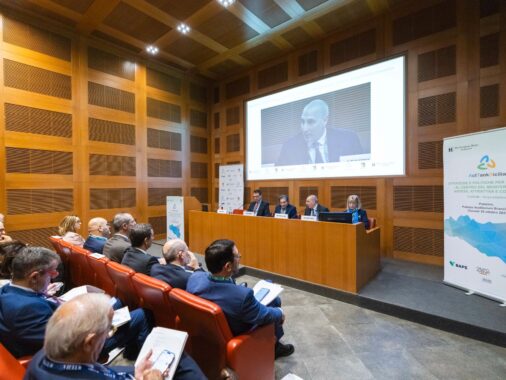
Below is a summary of the address delivered by Francesco Anghelone, Senior Researcher at the Institute and Scientific Coordinator of the Mediterranean Observatory, at the conference “Africa and Its Future”, held on 28 January in the “Aula degli organi collegiali” at the Rectorate Building of Sapienza University of Rome.
Europe and Africa: A Strategic Relationship
The relationship between Europe and Africa is acquiring decisive strategic importance in an international context marked by the return of great-power competition, the fragmentation of global balances, and the emergence of new forms of interdependence that span the Mediterranean and African regions. The Mediterranean and Africa can no longer be viewed as peripheral areas of European action, but rather as a single geopolitical space in which security, energy, migration, infrastructure, trade, investment, and value chains intersect with increasing intensity. This awareness underpins the recent ‘Pact for the Mediterranean’, approved by the Council of the European Union in November 2025, which represents the most ambitious attempt in decades to redefine the EU’s approach to a region that has become the focal point of major strategic challenges.
The changing global landscape shows how infrastructure, digital technologies, energy supplies, and trade routes have become arenas of geopolitical competition, with the Mediterranean functioning as a crucial zone connecting European security, regional stability, and global influence. Economic data confirm an already significant relationship: the Southern Neighbourhood accounts for 4.1 percent of the EU’s total trade, while the Union is the region’s leading trading partner, with a 41 percent share of its exchanges. This reflects a substantial interdependence, which nonetheless reveals a potential still largely untapped.
In this context, Africa is emerging as one of the central geopolitical poles of the twenty-first century. Demographic trends, which will bring the continent’s population to 2.5 billion by 2050, place it inevitably at the heart of global transformations in terms of workforce, urbanization, and demand for services. Its energy and mineral resources are essential for the green and digital transitions, while urban growth and the spread of digital technologies are opening new opportunities for investment, innovation, and economic cooperation. These developments shape Europe’s main strategic priorities: energy diversification, food security, the regulated management of migration flows, and regional stability, especially in the Sahel, where political instability, insecurity, and coups d’état have a direct impact on European interests.
The construction of effective partnerships is nevertheless complicated by the political and institutional fragilities of several countries, as illustrated by the case of Tunisia, where since 2021 power is concentrating in the hands of President Kaïs Saïed, with consequences for the rule of law, public policy, and cooperation with the European Union. In the Sahel, the series of coups d’état and the spread of jihadist groups have further highlighted the link between regional instability, migration routes, and European security. Added to this is the growing presence of external actors: China, which over the past two decades has consolidated its influence through loans and infrastructure projects amounting to more than 180 billion dollars, and Russia, which has established itself primarily in the security sphere in countries such as Mali, Niger, the Central African Republic, and Libya. This international competition reduces the opportunity for European action and strengthens more transactional negotiating approaches among African partners.
In response to this situation, the Pact for the Mediterranean outlines a strategy based on an integrated approach that highlights three fundamental dimensions: people, economy, and cooperation on security and migration. At its core lies the human dimension, with investments in human capital, academic mobility, training, research, and the strengthening of civil societies, all recognized as essential conditions for stable political and economic relations. The economic potential of trade remains significant: in 2024 the EU imported goods worth 120 billion euros from the Euromed-10 countries and exported goods worth 126 billion euros to the region – figures that are substantial yet still below the possibilities identified in European assessments. The Pact also calls for an increase in dedicated financial resources, estimating a requirement of 42 billion euros for the 2028-2034 period, to be incorporated into negotiations for the Union’s multiannual budget.
In this context, the Mattei Plan also plays a key role as the instrument through which Italy seeks to build equitable partnerships focused on achieving concrete results. The Plan emphasizes the creation of shared value, as illustrated by the ‘smart agriculture’ programme developed by Leonardo and BF SpA, which combines advanced technologies, training, and the strengthening of local supply chains. The investments announced by the BF group – amounting to 400 million euros over three years -reflect an approach based not on assistance, but on collaboration and the enhancement of local capacities.
The Pact for the Mediterranean and the Mattei Plan both fall within the broader framework of Global Gateway, the European strategy launched in 2021 to promote sustainable infrastructure and strengthen global connectivity through a model presented as an alternative to the Chinese approach. With the objective of mobilising 300 billion euros by 2027, the initiative includes an Africa – Europe investment package worth 150 billion euros dedicated to clean energy, digitalisation, transport, climate resilience, and the development of institutional capacities, with particular emphasis on transparency, sustainability, and good governance.
Together, these initiatives reflect a growing recognition that Europe’s future will also depend on its ability to build a cooperative Mediterranean space and a strategic partnership with Africa. The challenge lies in translating instruments and declarations into coherent action, targeted investments, and a long-term geopolitical vision, overcoming emergency-driven and fragmented approaches. An Africa regarded as an actor rather than a problem, and a Mediterranean understood as an integrated space rather than a frontier, are essential conditions for ensuring Europe’s stability, security, prosperity, and strategic autonomy in the decades ahead.
Francesco Anghelone